





I. Project Background and Requirements
Driven by the national "dual carbon" strategy and green building policies, energy-saving renovation of public buildings has become a key livelihood project during the "15th Five-Year Plan" period. As underground parking garages are major "power consumers" in building energy usage, traditional lighting systems commonly suffer from issues such as wasted energy from always-on lights, short lamp lifespans, high maintenance costs, and poor lighting experience. According to industry field tests, lighting energy consumption in underground parking garages accounts for 20%-30% of total building energy consumption, and over 70% of the time, lighting remains in an ineffective state with no people or vehicles present, leaving enormous potential for energy savings.
In the Zitang Junxi Smart Digital Community project, Shaanxi Yunong Yunzhi Intelligent Technology Co., Ltd. has already implemented basement floor renovation and lighting fixture installation works. Building on this foundation, the company leverages its weak-current intelligent system integration capabilities along with IoT and AI technology infrastructure to launch a comprehensive smart parking garage lighting solution, aiming to achieve refined, intelligent, and energy-efficient management of garage lighting through "high-efficiency LED light sources + radar sensing + IoT intelligent control," establishing a benchmark for green, low-carbon smart parking garages.
II. Overall Solution Design
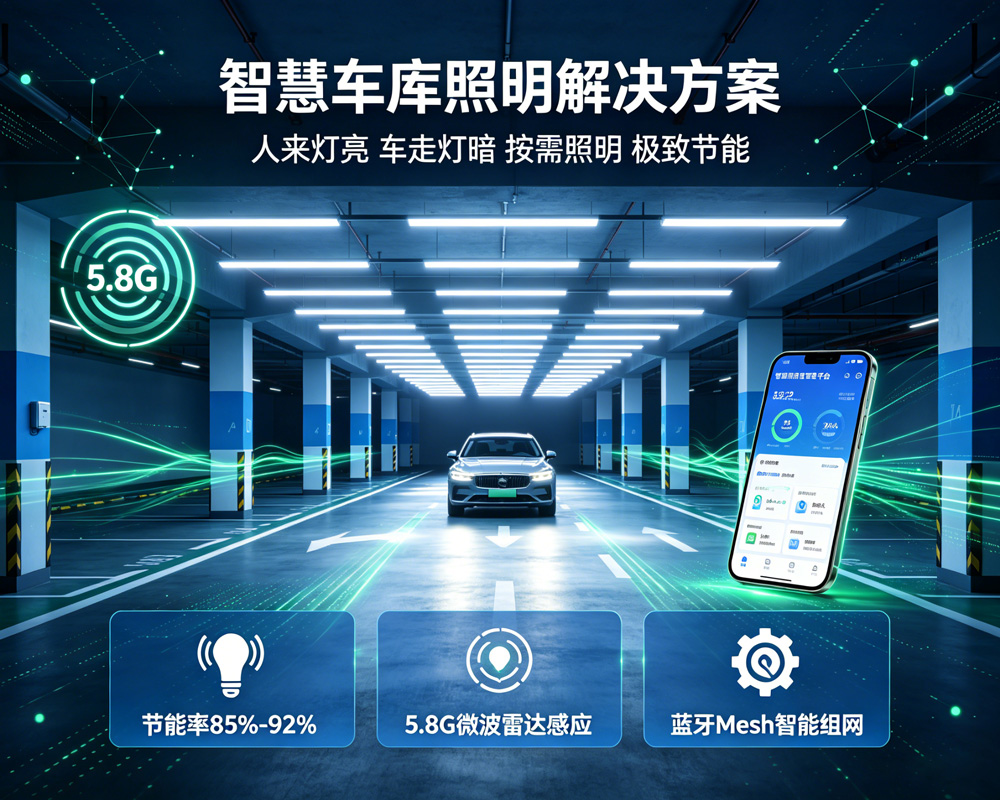
The solution is built upon four core principles: "energy efficiency, intelligence, safety, and high performance." It comprehensively eliminates original high-energy-consuming fluorescent lamps or ordinary LED lights, introducing an IoT-enabled intelligent sensing LED lighting system to establish a smart lighting control model of "lights on when people arrive, lights dim when vehicles pass, and low power consumption when unoccupied."
The system adopts a three-layer "device-network-cloud" architecture: On the device side, high-efficiency LED smart tubes with built-in 5.8G microwave radar sensing modules are deployed to achieve precise detection of human and vehicle movement and local dimming control; on the network side, Bluetooth Mesh self-organizing networking or PLC power line communication enables interconnection and data transmission between luminaires without additional wiring; on the cloud side, a smart lighting management platform is established, providing functions such as remote monitoring, energy consumption statistics, fault alerts, and policy configuration, with seamless integration into IBMS intelligent integration platforms and energy management systems.
III. Core Technologies and Functions
(1) 5.8G Microwave Radar Sensing. The luminaires are equipped with built-in 5.8G microwave radar sensing chips that detect moving objects based on the Doppler effect, with sensing distances flexibly adjustable from 1 to 8 meters. Compared with traditional infrared sensing, radar sensing is not affected by ambient temperature, humidity, or airflow interference, and can penetrate non-metallic materials such as plastic and glass, providing more accurate recognition and faster response, making it perfectly suited to the complex environment of underground parking garages.
(2) Stepless Dimming and Echelon Linkage. The luminaires support 0-100% stepless dimming. When no people or vehicles are present, they maintain a 10%-20% micro-brightness state (meeting the minimum illumination requirements for security surveillance). When people or vehicles are detected approaching, the lights smoothly ramp up to full brightness within 1 second, and after people or vehicles leave, they gradually dim back down after a 30-60 second delay. Echelon linkage control is also supported: when a vehicle is driving, lights within the driver's forward field of view illuminate in advance; at intersections, lights in all four directions illuminate simultaneously; and after the driver parks and walks toward the elevator, the path remains lit. Throughout the entire process, users are barely aware of lighting adjustments, achieving a "seamless intelligent" experience.
(3) Zoned and Time-Scheduled Control. The system divides the garage into independent control circuits by zones such as drive lanes, ramps, parking spaces, and entrances/exits, allowing differentiated lighting strategies for different areas. It supports automatic switching between multiple time periods including off-peak, peak, and nighttime modes. For example, from 23:00 to 6:00 the next day, the system automatically enters deep energy-saving mode, reducing brightness to 5% when unoccupied. During holidays or special events, full-brightness mode can be activated with one click to meet diverse scenario requirements.
(4) Fire Emergency Linkage. The system is linked with the fire alarm system. In the event of an emergency such as a fire, all luminaires automatically switch to full-brightness emergency mode to ensure adequate lighting for personnel evacuation. Additionally, the emergency lighting circuit is independently designed to ensure continuous operation for no less than 90 minutes during power outages, in compliance with national fire safety regulations.
(5) Intelligent Operations and Energy Management. The smart lighting platform monitors the operating status, power, illumination level, and online status of each luminaire in real time. Lamp faults trigger automatic alerts with precise location identification. Operations and maintenance personnel can remotely adjust parameters and perform batch upgrades via a mobile APP without on-site visits to each individual lamp, improving O&M efficiency by over 80%. The platform automatically generates daily, monthly, and annual energy consumption statistical reports, supports zoned and time-based energy consumption comparison analysis, and provides data support for energy-saving optimization. Lighting electricity consumption data can be synchronously uploaded to the park's energy monitoring platform.
IV. Implementation Path
The project is implemented in three phases: Phase 1 (Survey and Design) involves a comprehensive survey of the existing lighting circuits, luminaire layout, and electricity usage in the parking garage, along with the development of customized renovation plans and energy-saving calculations; Phase 2 (Construction and Renovation) involves replacing lamps with intelligent LED tubes, installing gateways and control equipment, and deploying the smart lighting platform. During construction, zoned work methods are adopted to minimize impact on normal garage usage; Phase 3 (Commissioning and Operation) involves system integration testing, optimization of sensing parameters and lighting strategies, operations and maintenance training, and final handover for formal operation.
V. Expected Outcomes and Economic Benefits
After implementation, the energy-saving effects are significant: In terms of light source energy reduction, traditional 36W fluorescent lamps are replaced with 9-12W intelligent LEDs, achieving a direct energy reduction of over 66%; in terms of control energy reduction, through radar sensing and intelligent dimming, energy consumption during unoccupied periods is reduced to 10%-20% of original levels. The comprehensive energy-saving rate can reach 85%-92%. Taking a medium-sized garage with 1,000 luminaires as an example, annual electricity cost savings amount to approximately RMB 150,000-200,000, with an investment payback period of only 1-2 years.
At the same time, lamp lifespan is extended to over 50,000 hours, and maintenance costs are reduced by 70%. The lighting experience is significantly enhanced—the intelligent mode of "lights on when vehicles arrive, lights dim when vehicles leave" not only ensures traffic safety but also elevates the overall quality of the garage. The system integrates with IBMS and energy platforms, achieving digitalized, visualized, and intelligent management of garage lighting, providing strong support for green building certification and low-carbon operations of the project, and establishing a demonstration benchmark for smart garage lighting in the Yulin region.