





I. Project Background and Requirements
In October 2025, the State Administration for Market Regulation approved and released the mandatory national standard "Hygienic Standard for Lighting and Illumination in Primary and Secondary School Classrooms" (GB 7793—2025), which will come into official effect on November 1, 2026. The new standard achieves historic breakthroughs in technical indicators: the maintained average illuminance requirement for desk surfaces has been significantly raised, and key indicators such as daylighting uniformity, retinal blue light hazard limits, flicker depth, and flicker index have been newly added. In particular, Clause 5.1.5 explicitly stipulates that in ordinary classrooms using multimedia teaching, each chalkboard lighting fixture shall be equipped with an independent dimming or illuminance reduction control device, making independent dimming of chalkboard lights a mandatory requirement. Meanwhile, the Ministry of Education's "Bottom-Line Requirements for Basic School Running Conditions in Primary and Secondary Schools" lists classroom lighting compliance as a hard indicator, and the Guiding Opinions on Building Healthy Schools identifies comprehensive myopia prevention and control as a key task. Driven by both policies and standards, classroom lighting renovation has shifted from "optional" to "mandatory."
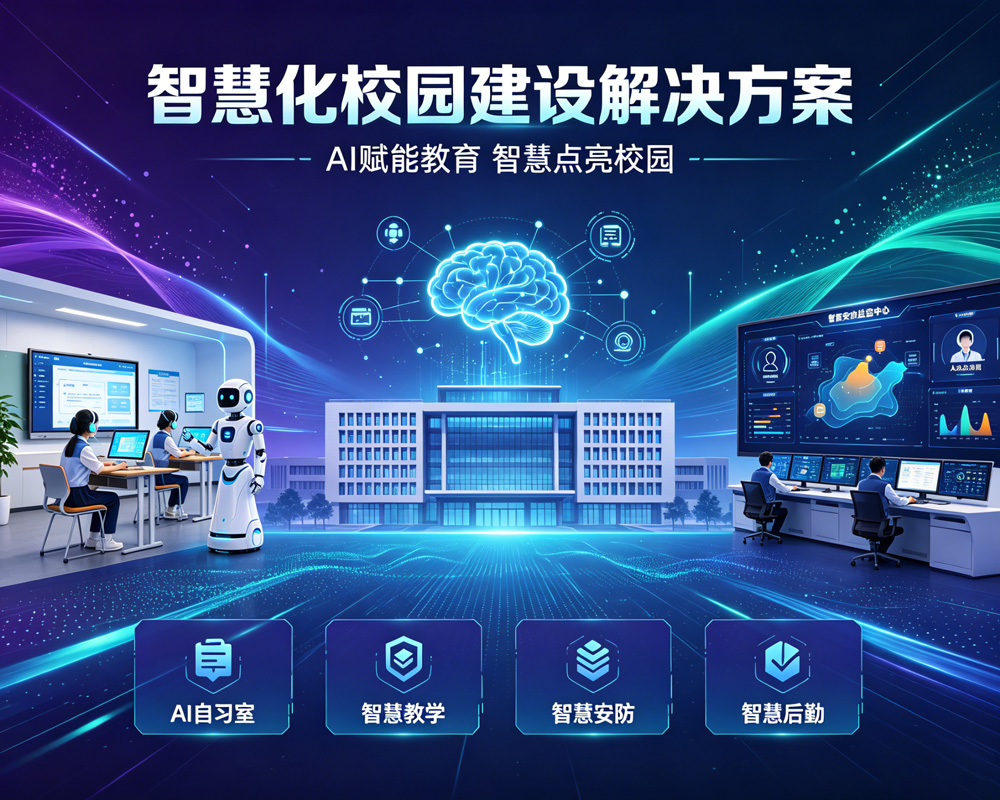
Shaanxi Yulong Yunzhi Intelligent Technology Co., Ltd. has cooperated with the Education Bureau of Yuyang District, Yulin City, to carry out smart campus construction at Yulin No. 1 Middle School and No. 17 Primary School, covering pilot projects such as AI self-study rooms and security monitoring. On this basis, the company leverages its weak-current intelligent system integration capabilities and IoT and AI technology foundation to launch a comprehensive smart classroom lighting solution, aiming to create a smart classroom lighting environment that meets the new national standard, protects students' eyesight, and is energy-efficient through "full-spectrum eye-protective luminaires + IoT intelligent control + scenario-based light environment management," helping Yuyang District's educational lighting upgrade take the lead in the city.
II. Overall Scheme Design
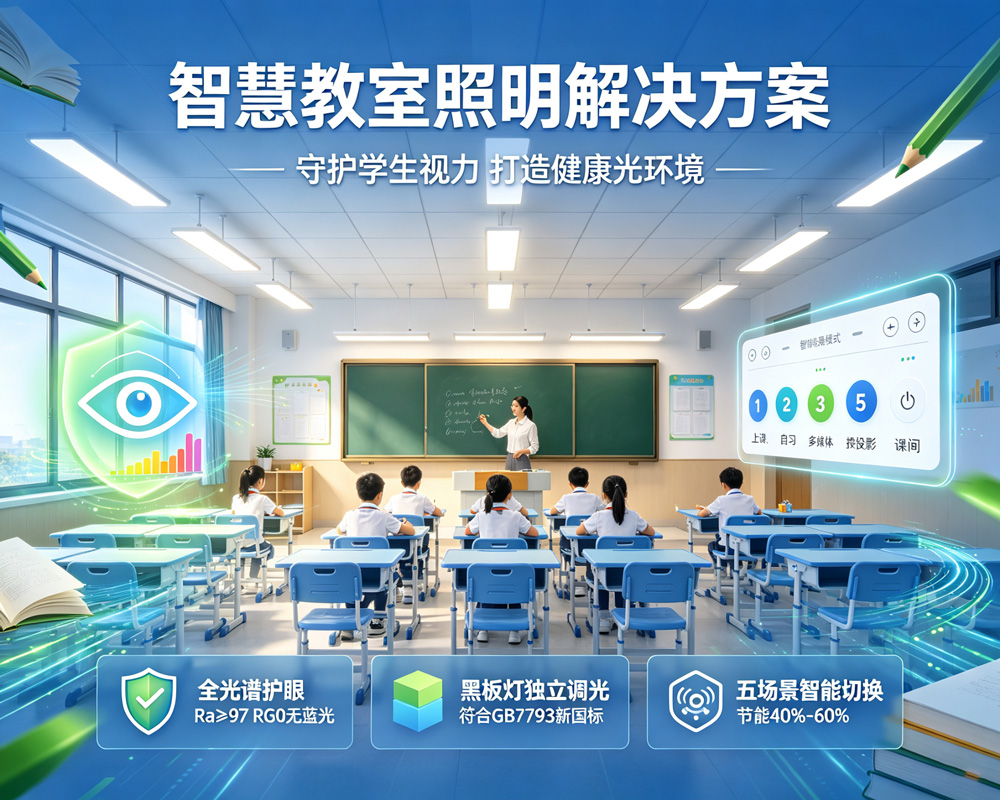
The scheme is based on the four core principles of "healthy eye protection, intelligent control, energy efficiency, and compliance with standards," comprehensively eliminating original fluorescent lamps or ordinary LED lamps, introducing full-spectrum eye-protective LED classroom lights and chalkboard lights, paired with an IoT intelligent lighting control system, to build a smart light environment management model with one-touch switching among five scenarios: "lecture, self-study, multimedia, projection, and recess."
The system adopts a three-layer architecture of "end-network-cloud": at the end layer, full-spectrum eye-protective classroom lights, independently dimmable chalkboard lights, intelligent control panels, illuminance sensors, and human presence sensors are deployed to achieve precise lighting and environmental perception; at the network layer, WF-IoT or Bluetooth Mesh self-organizing networking enables interconnection and data transmission between luminaires without additional wiring; at the cloud layer, a smart lighting management platform is built, providing remote monitoring, energy consumption statistics, fault alarms, scenario configuration, batch upgrades, and other functions, which can seamlessly integrate with smart campus platforms and IBMS systems.
III. Core Technologies and Functions
(1) Full-spectrum eye-protective luminaires. Full-spectrum LED light sources are adopted, with spectra close to sunlight and soft light color. The classroom light color temperature is 5000K, with a color rendering index of Ra≥97 and R9≥93, providing high color fidelity; the unified glare rating UGR<19,防眩格栅设计实现"见光不见灯";蓝光危害等级RG0(无危害),无可视频闪,波动深度与闪变指数符合新国标要求。黑板灯采用偏光透镜设计,照度均匀度≥0.8,确保黑板各区域亮度一致,无反光死角。所有灯具通过3C认证与教育照明专项检测,寿命长达50000小时。
(2) Independent dimming of chalkboard lights. Strictly responding to the mandatory requirement of Clause 5.1.5 of GB 7793—2025, each chalkboard light is equipped with an independent dimming control device. When teachers use multimedia projection for teaching, the chalkboard light illuminance can be reduced to 30%–50% with one touch, preventing chalkboard light reflection from affecting projection image clarity; under normal lecture mode, full brightness is restored to ensure clear visibility of chalkboard writing. Each light supports independent 0–100% stepless dimming to meet the needs of different teaching scenarios.
(3) Multi-scenario intelligent control. Five standard lighting scenarios are preset, and teachers can switch with one touch via wall-mounted intelligent panels or a mobile APP: lecture mode (classroom lights + chalkboard lights at full brightness, desk surface illuminance ≥500lx); self-study mode (classroom lights at full brightness, chalkboard lights dimmed, creating a focused learning atmosphere); multimedia mode (classroom lights dimmed to 60%, chalkboard lights dimmed to 30%, ensuring projection clarity); projection mode (classroom lights dimmed to 20%, chalkboard lights off, maximizing projection effect); recess mode (classroom lights dimmed to 70%, chalkboard lights off, soft light to relax the eyes). Automatic timed scenario switching based on the class schedule is supported, requiring no manual operation.
(4) Daylight-linked control and human presence sensing. Classrooms are equipped with illuminance sensors that monitor natural light intensity in real time. When outdoor sunlight is sufficient, luminaire brightness is automatically reduced; on cloudy days or in the evening, automatic supplementary lighting is provided, always maintaining desk surface illuminance stably within the standard range and maximizing natural light utilization for energy savings. Human presence sensors are installed so that lights automatically turn off or enter low-power standby mode when the classroom is unoccupied, and automatically restore the preset scenario when someone is present, eliminating the waste of "always-on lights."
(5) Smart operation and maintenance and energy management. The smart lighting platform monitors the operating status, power, illuminance, and online status of each luminaire in real time. Luminaire faults trigger automatic alarms with precise location identification. Maintenance personnel can remotely adjust parameters and perform batch upgrades via a mobile APP without on-site visits to each luminaire. The platform automatically generates daily, monthly, and annual energy consumption statistics reports, supporting comparative analysis by classroom, floor, and time period, providing data support for energy-saving optimization. Lighting data can be synchronously uploaded to the smart campus management platform to achieve unified management of campus facilities.
IV. Implementation Path
The project is implemented in three phases: Phase 1 (survey and design), conducting a comprehensive survey of the existing lighting, wiring, and daylighting conditions of each classroom, and developing personalized renovation plans and illuminance simulation calculations in accordance with GB 7793—2025; Phase 2 (construction and renovation), replacing with full-spectrum eye-protective classroom lights and independently dimmable chalkboard lights, installing intelligent panels, sensors, and gateways, and deploying the smart lighting platform, with construction carried out during winter/summer vacations or weekends to minimize impact on teaching; Phase 3 (commissioning and acceptance), conducting illuminance measurements and scenario joint commissioning in each classroom one by one to ensure all indicators meet the new national standard, providing teacher training, delivering formal operation, and submitting third-party testing reports.
V. Expected Outcomes
After implementation of the scheme, the classroom lighting environment fully meets the standard: maintained average illuminance on desk surfaces ≥500lx, illuminance uniformity ≥0.7, chalkboard surface illuminance ≥750lx, UGR<19,显色指数Ra≥97,蓝光危害RG0,无可视频闪,全部指标符合GB 7793—2025强制性标准,为学生视力健康提供坚实硬件保障。智能控制与自然光联动使照明能耗降低40%—60%,以一所30间教室的学校为例,年节约电费约3—5万元,灯具寿命延长至50000小时,维护成本降低70%。同时,智慧照明系统与AI自习室、智慧安防等系统联动,构建完整的智慧校园生态,打造榆林市教育照明智能化改造示范标杆。