
一、项目背景与需求
The national "Healthy China 2030" strategy is being advanced in depth. In November 2025, the National Health Commission issued the "Implementation Opinions on Promoting and Regulating the Application Development of 'AI + Healthcare'", explicitly promoting applications such as intelligent medical imaging diagnosis, AI-assisted diagnosis and treatment, and intelligent health management for key populations. The "15th Five-Year Plan" for medical insurance deploys the construction of the "Personal Medical Insurance Cloud", promoting the integration of data from wearable devices and home intelligent monitoring devices with in-hospital diagnosis and treatment data. Driven by both policy and technology, smart healthcare has moved from informatization construction to a new stage of full-scenario intelligence empowered by AI.
As a regional central city in northern Shaanxi, Yulin concentrates high-quality medical resources in municipal-level hospitals, while primary healthcare institutions have weak diagnostic and treatment capabilities, making it inconvenient for residents in remote counties to access medical services; the number of chronic disease and elderly patients is growing, and traditional follow-up management models are inefficient; and there is insufficient capacity for high-end medical device R&D and clinical translation. Shaanxi Yunong Yunzhi Intelligent Technology Co., Ltd., relying on the industrial resources of Yunong Technology Group (stock code: 834487), possesses weak-current intelligent system integration capabilities as well as AI, IoT, and big data technology foundations. It has planned to build Yulin's first clinical large animal experimental base in cooperation with Jiangsu Meifengli Company, and to develop degradable lumen treatment stents and interventional devices in cooperation with Sichuan Xingtaipule Medical Technology Co., Ltd., enabling it to provide integrated solutions for Yulin's smart healthcare innovation.
II. Overall Architecture
The solution adopts a four-layer architecture: "perception layer - network layer - platform layer - application layer". The perception layer deploys wearable devices such as intelligent blood pressure monitors, blood glucose meters, ECG monitors, and smart wristbands, as well as in-hospital IoT terminals, to achieve real-time collection of vital signs and diagnosis and treatment data; the network layer relies on 5G and dedicated medical networks to ensure secure and efficient data transmission; the platform layer builds a regional medical big data center, integrating in-hospital systems such as HIS, LIS, and PACS with out-of-hospital health monitoring data, providing basic capabilities such as AI model training, data governance, and security control; the application layer targets three types of users—hospitals, primary healthcare institutions, and patients—providing scenario-based services such as telemedicine, AI-assisted diagnosis, smart health management, and medical device R&D.
三、核心应用模块
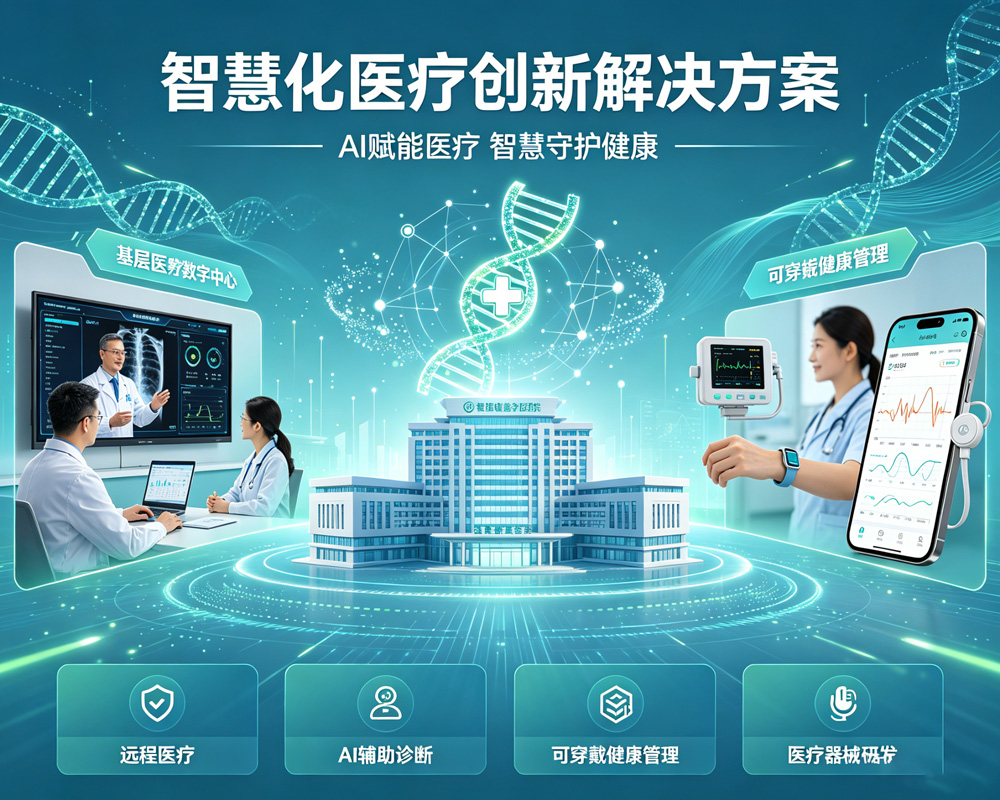
(1) Telemedicine collaboration platform. Build a telemedicine collaboration system covering the four levels of city, county, township, and village, supporting services such as video consultation, remote consultation, remote imaging diagnosis, and remote ECG monitoring. Experts from municipal tertiary hospitals can conduct online diagnosis and technical guidance for primary-level patients through the platform, breaking through time and space limitations and bringing high-quality medical resources directly to the grassroots. Supporting functions such as remote appointment, electronic prescription circulation, and drug delivery will be built, forming a new hierarchical diagnosis and treatment model of "primary-level first visit, remote consultation, and two-way referral".
(2) AI-assisted diagnosis system. Introduce a medical imaging AI-assisted diagnosis engine covering common imaging types such as lung CT, fundus, and pathological slides, supporting automatic lesion recognition, measurement and annotation, report generation, and treatment plan recommendations, thereby improving the efficiency of imaging diagnosis and report quality. Deploy AI-assisted diagnosis and treatment systems in primary healthcare institutions, covering more than 200 common disease types, providing functions such as differential diagnosis, medication recommendations, and medical record quality control, assisting primary-level doctors in standardizing diagnosis and treatment practices and improving the initial diagnosis accuracy rate. Establish a regional pathology AI medical consortium: county-level hospitals upload digital slide scans to the cloud, AI automatically performs preliminary screening and marks suspicious areas, and municipal-level hospital pathologists review them, achieving "county-level diagnosability".
(3) Wearable devices and smart health management. Equip patients with chronic diseases such as hypertension, diabetes, and cardiovascular disease, as well as key populations including the elderly and pregnant women, with devices such as intelligent blood pressure monitors, blood glucose meters, ECG monitors, and smart wristbands, to collect vital sign data such as heart rate, blood pressure, blood glucose, and blood oxygen in real time and automatically upload it to personal health records. The platform dynamically analyzes the data based on AI algorithms, automatically issues alerts for abnormal indicators and pushes them to contracted family doctors, enabling early intervention for diseases. In conjunction with the construction of the "Personal Medical Insurance Cloud", it promotes the integration of out-of-hospital health monitoring data with in-hospital diagnosis and treatment data, building a full-cycle health profile for patients and providing personalized health management and diagnosis and treatment plans.
(4) Clinical large animal experimental base and medical device R&D. In cooperation with Jiangsu Meifengli Company, build Yulin's first clinical large animal experimental base, providing services such as large animal experiments, efficacy evaluation, and safety testing in the fields of cardiovascular, neurology, and orthopedics, filling the gap in the region's high-end medical device R&D and translation platform. In cooperation with Sichuan Xingtaipule Medical Technology Co., Ltd., develop a series of degradable lumen treatment stent products and related interventional devices, complete preclinical validation based on the base, and promote the localized R&D and industrialization of high-end medical devices. Supporting services such as medical device registration application, clinical trial coordination, and industrial incubation will be built, creating a full-chain innovation ecosystem of "R&D - experimentation - translation - industrialization".
四、实施路径
The project will be advanced in three phases: Phase I (2026) completes the construction of the telemedicine platform and AI-assisted diagnosis system, selects 2 to 3 municipal hospitals and 5 to 8 primary institutions for pilot programs, equips 1,000 chronic disease patients with wearable devices, and initiates the construction of the clinical large animal experimental base; Phase II (2027-2028) expands the coverage of telemedicine and AI-assisted diagnosis, builds a regional medical big data center, extends wearable health management coverage to more than 50,000 people in key populations, puts the large animal experimental base into operation, and brings degradable stent products into preclinical validation; Phase III (2029-2030) deepens AI applications and data operations, and builds a regionally leading smart healthcare service system and medical device innovation and translation base.
V. Expected Outcomes
After the solution is implemented, Yulin's regional medical service capabilities will be significantly improved: telemedicine will cover more than 80% of primary healthcare institutions in the city, the standardization rate of primary-level diagnosis and treatment will rise to over 95%, AI-assisted diagnosis will shorten imaging report turnaround time by more than 50%, the standardized management rate of chronic disease patients will increase by 40%, and the early detection rate of abnormal indicators in key populations will be significantly improved. The clinical large animal experimental base and degradable stent R&D will fill the gap in the region's high-end medical device innovation, drive the clustering of industries such as medical technology, biomedicine, and health services, create employment opportunities, help Yulin build a regional medical center and a health industry innovation highland, and provide the public with more convenient, higher-quality, and more intelligent medical and health services.