
I. Project Background
With the full implementation of the national "15th Five-Year Plan" urban renewal initiative, the acceleration of urban lifeline safety projects, the renovation of the "six networks" of underground pipelines, and the "AI + urban governance" action, smart cities have moved toward integrated, domain-wide digital governance. As a core city of the national energy and chemical base, Yulin faces urgent challenges such as traffic congestion, fragmented security systems, inefficient energy consumption, and aging pipeline networks that require smart solutions. Relying on the industrial resources of Yunong Technology Group (stock code: 834487), Shaanxi Yunong Yunzhi Intelligent Technology Co., Ltd. possesses weak-current intelligent system integration capabilities and an AI, IoT, and big data technology foundation, enabling it to provide integrated solutions for Yulin's smart city development.
II. Overall Architecture
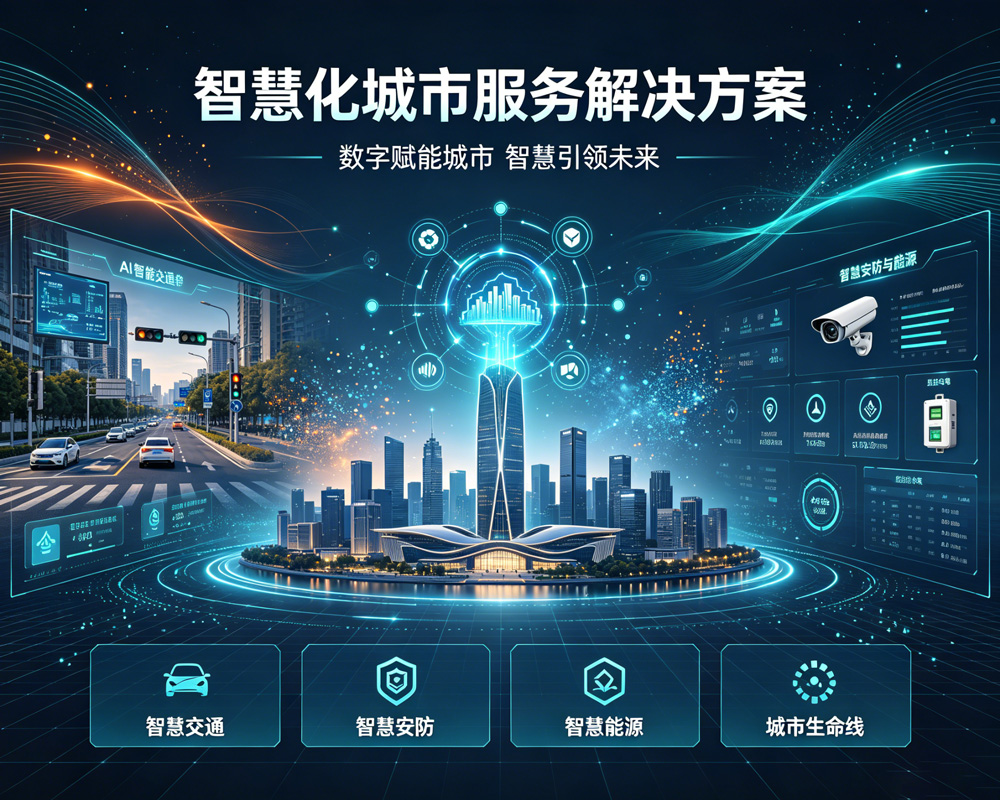
The solution adopts a five-tier collaborative architecture of "End - Pipe - Edge - Cloud - Application." The perception layer deploys intelligent cameras, millimeter-wave radar, water/gas/electricity meters, and environmental sensors to achieve holographic perception of city operations; the network layer relies on 5G and fiber-optic private networks to ensure low-latency data transmission; the edge layer deploys edge computing devices at roadside and pipeline network nodes for real-time local response; the platform layer builds a unified urban operation management hub, integrating multi-source data from transportation, security, energy, and municipal systems to break down departmental data silos; the application layer provides scenario-based smart services for government, enterprises, and citizens, with security and operations & maintenance running throughout.
III. Core Application Modules
(1) Smart Transportation. Deploy AI traffic signals and traffic flow sensing devices, dynamically adjusting signal timing based on real-time traffic flow, improving throughput on key road sections by over 20%; build intelligent recognition systems for violations such as illegal parking and red-light running; develop a smart parking platform that integrates on-street and off-street parking spaces, enabling parking space reservation, frictionless payment, and guidance navigation.
(2) Smart Security. Build a citywide intelligent video surveillance network, leveraging facial recognition and behavior analysis algorithms to enable automatic early warning of abnormal events and precise deployment for persons of interest; integrate multi-level surveillance resources from public security, communities, and merchants to establish a unified security dispatch platform; deploy smoke detectors and gas sensors in key areas, linked with fire protection systems for early hazard identification and automatic alarm.
(3) Smart Energy and Intelligent Water, Gas, and Electricity Management. Leverage smart electricity meters, water meters, gas meters, and pipeline sensors to build a real-time monitoring system for urban energy and public utilities; optimize through peak-valley electricity pricing guidance and load forecasting to reduce energy consumption in public buildings by over 15%; implement district metering and precise leakage control for water supply networks; conduct AI-based gas safety inspection analysis and hazard identification. The company launched pilot projects for intelligent water, gas, and electricity management in 2025, which can be gradually expanded based on this foundation.
(4) Urban lifeline monitoring. For underground pipe networks such as water supply, drainage, gas, and heating, deploy liquid level, pressure, and gas concentration sensors, combined with GIS to build digital twin models of the pipe networks, achieving real-time monitoring and dynamic early warning of operational risks to prevent accidents such as leaks and waterlogging.
IV. Implementation Roadmap
The project will be advanced in three phases: Phase I (2026) completes top-level design and platform construction, selects core urban areas to carry out pilot programs for smart transportation, security, and intelligent water, electricity, and gas systems, forming demonstration models; Phase II (2027-2028) expands coverage, completes the deployment of sensing terminals in major urban areas and system interconnection, and builds a unified urban operation management center; Phase III (2029-2030) deepens AI applications and data operations, and builds a smart city industrial ecosystem.
V. Expected Outcomes
After implementation, Yulin's refined urban governance capabilities will be significantly enhanced: the traffic congestion index will drop by over 15%, public safety incident response time will be reduced by 30%, energy consumption in public buildings will decrease by 15%, and the pipeline network leakage rate will decline markedly. Meanwhile, the solution will drive the clustering of upstream and downstream industries such as weak-current intelligence, IoT, and big data, create employment opportunities, help Yulin build a livable, resilient, and smart city, and inject digital momentum into high-quality regional economic development.